OFFICIAL WEBSITE OF DR S. SRIKANTA SASTRI, M. A., D. Litt (1904 - 1974)

.jpeg)

Studies in the Indus Scripts - I (Quarterly Journal of Mythic Society - Vol 24 - 3)

Studies in the Indus Scripts - I (Quarterly Journal of Mythic Society - Vol 24 - 3)
It has been the fashion to assume, following the lead of Sir John Marshall, that the Indian Culture was non-Aryan, on the grounds that the Aryans had no knowledge of towns, used horses and defensive armour and held the cow, and not the bull sacred; The Aryans also apparently had no image worship or that of the phallus. On such slender and mostly negative evidence, it is concluded that the Indus culture was pre-Aryan.
Leaving aside the fact that pars were known as strongholds of the Dasas, it is clear, as urged by Prof. S. V. Venkateswara (J. R. A. S., 1916), that some of the Vedic deities were conceived as anthropomorphic, and it is not impossible that figurines of the Earth Goddess or Agni were employed in ritual. The figure of a horse has recently been discovered at Mohenjo-Daro, and therefore it cannot be urged that the Indus culture was pre-Aryan. Nor can we urge a later date because domesticated horses were employed in Sumer a thousand years earlier than usually supposed. The excavations at Khafaje have revealed a plaque depicting a King leading a chariot drawn by four horses (Illustrated London News, October 8, 1932). Moreover, the chariots found in Sindh are exactly of the same type as described in the Rg Veda. The axle and the wheels were made of the same block, and the axle turned with the wheels (Rg. 1. 166. 9). The horse was not indigenous to Mesopotamia and was imported from the East, probably from the Sindh and Punjab. It is equally illogical to assume that the bull was not held in as high an esteem as the cow by the Aryans, for we find in the Vedic hymns, the comparison with the bull employed almost ad nauseam. To give only a few instances:
Published in Quarterly Journal of Mythic Society Journal - Vol 24, 3
©
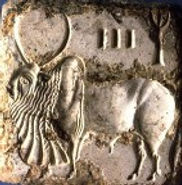
The Indus Bull Hieroglyphic
Page 1 of 7
Click on link to read full article