


Tekur Subramanyam
Updated: 1 hour ago

Tekur Subramanyam was born on 9 August, 1900 in Uruvakonda, Anantapur district, in erstwhile Andhra Pradesh. His parents were Rama Sastry and Seethamma.
Ancestry
Tekur Subramanyam’s ancestors hailed from Tekur village, situated 20 kms from Kurnool in Andhra Pradesh. They migrated to Bellary district in the early 18th century and stayed in the Fort area (Kallamma Temple Road), but were eventually displaced to Brucepet to accommodate the newly commissioned British Cantonment. They were originally landholding priests and astrologers by profession.

As early as 1800, the Nizam had ceded Bellary and Anantapur districts to the East India Company. This paved the way for many reputable schools, colleges, and printing presses to take root in Bellary. The ‘London Missionary Society’ established the first printing press in Bellary in 1815 and, as its first offering, published a handsome copy of the “Amara Kosha”. Later on, the first Kannada weekly titled ‘Bellary Bharathi ’, pioneered by K. M. Karibasava Sastry, made its appearance from the ‘Shankara Vilas Press’. Many leading Telugu papers of the day like ‘Sanmarga Patrika’ and ‘Vijaya Vedanta Chandrika’ had their origins in Bellary.

Among the earliest to arrive in Bellary were Narayana Sastry and Hanumakka. Narayana Sastry passed away at an early age. Narayana Sastry and Hanumakka had a son by the name of Rama Sastry, who had his education at the Wardlaw Institute. He used to suffer from bouts of depression and failed to complete his formal education. Instead, Rama Sastry turned to astrology and palmistry. He was married to Seethamma. Seethamma and Rama Sastry had a son on August 9, 1900, at Uruvakonda, Anantapur district. As the newborn babe lay in the crib, the mother was horrified to see a snake curled up close to the baby’s legs! She was paralysed with fear. Not knowing what to do, she made a vow to the presiding deity at Kukke Subramanya temple that she would name the child after him if he emerged unscathed. Miraculously, the snake slithered away, leaving the baby untouched, and the grateful parents named him Subramanyam! Tekur Subramanyam’s childhood was split between Uruvakonda and Bellary.

Subramanyam was fond of reciting verses by Vemana, Sumathi, Nrusimha Shatakam and also Bhartrhari Subhashitam. His father taught him the nuances of palmistry and astrology in detail. He was admitted to St. John’s School in the Fort area of Bellary in 1908. His grandmother Hanumakka admitted him to Wardlaw Institute in 1911 (In fact, generations of Tekur family members have been educated at Wardlaw Institute ever since!). At Wardlaw, Tekur Subramanyam came under the influence of many teachers who inspired in him a keen nationalistic sentiment. Foremost of them was Sanjeeva Rao, who taught Telugu & History and was fond of reading works of Mazzini, Garibaldi and Cavour. Tekur was particularly fond of singing Telugu poems and had a good voice. In addition to these academic pursuits, he was an avid sportsman who played Football, Chess, kabaddi, and Carrom as well. Tekur loved theatre and was famous for playing the role of Antonio in ‘The Merchant of Venice’. His classmates fondly called him ‘Subbu’. Tekur Subramanyam completed his matriculation in 1916. While his father was very keen to get him into a Government job, his grandmother, mother and elder brother Narayana Sastry had other plans for him. They encouraged him to pursue higher education at Madras. He joined Pachaiyappa’s College at Madras for his F. A. and B. A. courses in 1917. He graduated from Pachaiyappa’s College, Madras, in 1919. During these years, Tekur Subramanyam was made literary secretary of the college and participated at nationalist rallies on Marina Beach. Here, he had the opportunity to listen to stirring speeches by Annie Besant, Bipin Chandra Pal, Lokmanya Tilak and Surendranath Banerjee.

Tekur Subramanyam married Meenakshamma in 1921 at Hospet. He then enrolled in the law college to pursue his B. L. degree, which he completed in 1923. Thereafter, he settled in Bellary as a junior lawyer under Naganoor Narayana Rao. Around this time, Tekur Subramanyam joined the ‘Servants of India’ society, founded by Lala Lajpat Rai. His first son, Satyanarayana, was born in 1925.
Indian Independence Movement

Tekur Subramanyam, at 25 years of age, visited Wardha and stayed at Gandhiji’s ashram for three months. Interestingly, his family back home were under the impression that he was in Benaras during this period! During these three months, Tekur had his first brush with stalwarts like Mahadev Desai, N. V. Gadgil, N. S. Hardikar, R. R. Diwakar, Karnad Sadashiva Rao and Gangadhar Rao Deshpande. He would eventually accompany the Mahatma on his tour of Bombay Presidency across ten days in 1928.

Returning to Bellary, Tekur Subramanyam decided to give up his legal practice and plunge headlong into the Independence movement. He was involved in the ‘Shashana Banga’ movement at Bellary. He also vowed to wear only Khadi at all times and be bereft of any ornaments upon his person. Furthermore, he ceded his share in the ancestral properties, in favour of his brother and parents! In due course, he came to be known as ‘Bellary’s soldier of freedom’ in various circles in Wardha! His devotion to the national struggle and his all-pervasive sense of self-imposed frugality did not go unnoticed. The bungalow of Havalgi Seshagiri Rao was placed at Tekur’s disposal, and he ran his Gandhian activities from there. He embarked on a tour of the villages of Hadagli, Harappanahalli and Kudligi taluks. Tekur Subramanyam participated in ‘Ankola Satyagraha’ in 1930 and led the agitation for closure of toddy shops. These social activities, predictably, attracted the attention of people in Bellary.

The then Collector & District Magistrate of Bellary was an Anglo–Italian by the name of Arthur Galletti, who had been in the Indian Civil Service (ICS) since 1900. He was a polyglot who could speak several languages and was also a historian in his own right. He is best remembered for compiling the comprehensive “Galletti’s Telugu Dictionary” in 1935 and for his historical translation titled “The Dutch in Malabar”, published in 1911. Probably owing to his Italian heritage, there was always a palpable distance between him and his British superiors. Galletti’s supposed involvement in the ‘White Mutiny’ and subsequent refusal to raise a toast to King George V at a party at Horsleykonda on 24th May, 1918, made him notorious enough to be described in official correspondence as the ‘Maverick Collector of Ballari’! Ironically enough, he was so popular among the native population that he eventually came to be known as ‘The People’s Collector’. Mr Galletti once invited Tekur Subramanyam to his official residence for tea. This was immediately following Tekur Subramanyam’s participation in the ‘Ankola Satyagraha’. After tea, Mr Galletti very calmly remarked: “…Mr. Subramanyam, I have instructions from the Government to arrest you under the ‘Defence of India Rules’ for acts of treason. Do you plead guilty or not guilty? Kindly presume this to be a court of law and answer me..” Tekur Subramanyam replied with a gentle smile, “I plead guilty, sir”. Mr Galletti replied, “..Since you are guilty of treason towards His Majesty’s Government, you are hereby sentenced to six months’

imprisonment, and I am putting you in ‘A’ class. I am sending my vehicle to drop you home. We will meet again. May God bless you.” Tekur Subramanyam was eventually arrested and charged under section 118 of the Indian Penal Code (IPC). From Bellary Central Jail, he was subsequently transferred to Central Jail at Vellore as per the instructions of the Home Secretary of the Madras Government. While at Vellore, his first son, aged six years, passed away after a bout of pneumonia. Sadly, Tekur Subramanyam came to know of his son’s demise only after he was released from prison in March 1931, following the ‘Gandhi – Irwin’ pact! Years later, Mr Galletti met Tekur Subramanyam and lamented thus: “Mr Subramanyam, we Britons love freedom and had I been on the other side of the fence, I too would have fought for the freedom of my country. I always thank the Almighty for not putting Hitler as head of the British Government!”
After one of Gandhiji’s many tours, Tekur Subramanyam accompanied the Mahatma to the Hospet railway station to send him off from Bellary. At the station, Tekur Subramanyam sought Gandhiji’s forgiveness for any shortcomings that he may have experienced in his travels through their district. Gandhiji brushed aside his apology and remarked that, whenever he thought of Karnataka, two people always came to his mind and incidentally both of them had the same name – T. Subramanyam. One was Talekere Subramanyam and the other Tekur Subramanyam!

Mahatma Gandhiji visited Bellary for the first time in 1921. At that time, the Congress party in Bellary had two opposing factions that were continuously at war with each other. This was a major embarrassment to the Congress Party members at the national level. After Gandhiji’s address to a rather large gathering, he waited for the party volunteers to take him to the railway station. Realising that they were far too engrossed in settling scores, he made his way to the station, all by himself! To his dismay, he found he had missed the train. He then decided to take the next train, which wasn’t expected till early the next morning. The next day, he purchased his own ticket and made his way on to the first train. Years later, Tekur Subramanyam met Mahatma Gandhi at a meeting. When Gandhi heard the word Bellary, the first thing he asked Tekur Subramanyam was, with regard to which camp he belonged to?! Tekur Subramanyam rather sheepishly answered that, at present, there was indeed only one Congress faction at Bellary and he was, in fact, its Secretary! Gandhiji raised his hands and exclaimed with a sigh of relief “…God be praised!”
Karnataka Kesari

Tekur Subramanyam began his Kannada weekly magazine titled ‘Karnataka Kesari’ on Oct 2, 1931, to propagate Gandhian ideals and values. He received a letter of encouragement from Pt. Jawaharlal Nehru on the august occasion. Interestingly, the idea for the magazine took shape while he was in prison with Rajaji. Drawing a parallel, Rajaji later remarked that the magazine took its birth in jail, much like Lord Krishna! The response from the colonial government was quick, and a hefty fine of 10,000.00/- rupees was imposed on Tekur Subramanyam! Eventually, ‘Karnataka Kesari’ had to cease its operations after the passage of ‘The Ordinances & Defence of India Rules’, during the second phase of the “Civil Disobedience Movement”.
These obstacles did little to quell his patriotic spirit. He plunged headlong into the ‘Civil

Disobedience Movement’ and was once more arrested and kept in Bellary jail for a period of six months. He was then transferred to Central Jail at Vellore. Sadly, Tekur Subramanyam’s elder brother Narayana Sastry succumbed to Tuberculosis in 1934. Tekur Subramanyam was released from prison in 1934. In the same year, Tekur Subramanyam joined Gandhiji on his ‘South Indian Harijan Seva’ tour and took him on a tour of Sandur State as well.
Madras Years

C. Rajagopalachari led the first Congress Government in Madras (under British rule) between 1937 and 1939, and invited Tekur Subramanyam to be his personal secretary. Gangadhar Rao Deshpande made Tekur Subramanyam a member of the ‘Gandhi Seva Sangha’ at Madras in 1937. In time, Tekur was promoted to the post of Assistant Secretary of the Congress Legislature Party. Tekur Subramanyam decided to settle down at Madras – Triplicane with his family for a few years. During this time, Tekur took the trouble of editing & publishing the ‘Directory of Madras Legislature Party’, earning him accolades and recognition from Rajaji.
Back to Mysore State
Tekur Subramanyam and R. R. Diwakar approached Prof. B. M. Srikantaiah, who was then at the helm of affairs of Kannada Sahitya Parishat, seeking his help and guidance in preparing an appropriate curriculum for the proposed Kannada textbooks in Mysore State.
Tekur Subramanyam started a Satyagraha camp at Bellary with just fifty volunteers. His increasing involvement in the ‘Satyagraha Movement’ got him arrested in Nagpur, and he was once more sent back to Bellary jail in January 1941! He was sentenced to rigorous imprisonment for a period of six months.

By 1942, the ‘Quit India Movement’ had gained momentum and Tekur took an active role in its organisation and execution in the Bellary district. He was yet again arrested and sentenced to rigorous imprisonment for a period of two years at Bellary. He was subsequently transferred to Central Jail at Vellore, where his inmates included Rajaji, Pattabhi Seetharamaiah, Bindu Madhava Rao, Nageswara Pantulu, Vaidyanath Iyer and Kamaraj. His transfer to Vellore jail was not informed to his immediate family members. He was denied access to newspapers and radio.

In jail, Rajaji took the responsibility of boosting the inmates’ morale and began delivering discourses on the Ramayana, Mahabharata and Bhagavad Gita. Tekur Subramanyam was popular for his lectures on politics and the history of revolution, in different countries like Italy, Ireland, France and Austria. He also took it upon himself to conduct a host of cultural programmes to address homesickness among the inmates. Plays based on social themes of dowry, child marriage and women’s rights were staged by the inmates of the jail. Tekur Subramanyam became a father figure to these youngsters and managed the Vellore jail like a University!
Tekur Subramanyam’s father Rama Sastry passed away in November of 1942, and the government saw fit to release him on parole for a fortnight to attend to his father’s last rites. Following the funeral, he reported back to prison. His second son, Tekur Ramanath, was born in 1943. Tekur Subramanyam would eventually be released from prison in 1944, whereupon he got to see his second son for the first time! In all, Tekur Subramanyam served four prison sentences, spread out across Bellary, Vellore and Tanjavur jails, over several years!
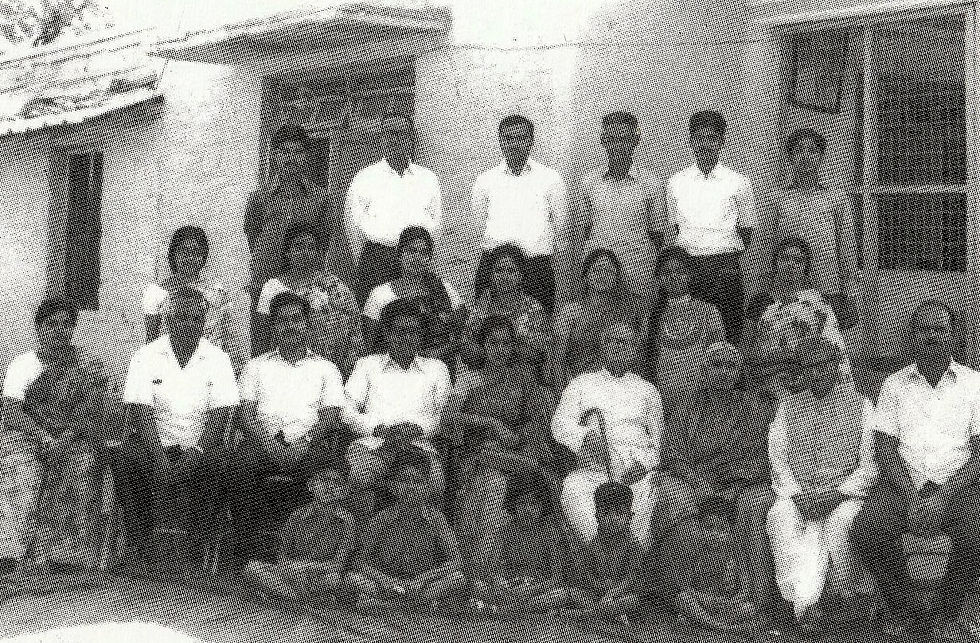
A great deal of fortitude and resolve was shown by Tekur’s wife Meenakshamma, who ran the household in his continued absence for years, often not knowing where he was or when he would be set free! Having lost her first son, Meenakshamma struggled on to run the house undeterred. Interestingly enough, in spite of many setbacks, her nationalistic sentiments were no less patriotic than her husband’s! She was known for her expertise with the Charaka wheel and presented Tekur Subramanyam with home spun Jhubbas and Dhotis, from time to time.
Tekur Subramanyam would eventually hoist the tricolour flag on August 15, 1947, at Sambamoorthy Maidan, Bellary, with Pandit Nehru’s speech being broadcast over loudspeakers in the background. Tekur Subramanyam was quite emphatic in his stand that, ‘… had not the hawks in the Congress party not placed their own interests above that of the nation, then the partition could have been avoided, altogether!’

On the day Mahatma Gandhiji was assassinated, Tekur Subramanyam’s family was plunged into unspeakable grief, and they decided to observe a fast while chanting the Bhagavad Gita. Tekur Subramanyam made the trip to Hyderabad to bring home Mahatma’s ashes. He immersed them in the Tungabhadra River near Hampi and performed all the rituals a son would perform for a departed father.
To make ends meet, Tekur Subramanyam and his compatriot Govind Das started the ‘Tekur Transport Service’ in 1948. Sadly, this venture met with little success and was abandoned by 1953.
Tekur Subramanyam, as a Statesman

Tekur Subramanyam was Political Secretary to Prime Minister Pt. Jawaharlal Nehru. Independent India’s first General Election was held in 1952. Tekur Subramanyam was nominated for the post of Member of Parliament from Bellary and won the election with a comfortable majority. He won two more times from Bellary in 1957 and 1962. He voluntarily announced his retirement from active politics after his third term as Member of Parliament from Bellary. Only after Tekur’s withdrawal could Dr V. K. R. V. Rao (then Education Minister in Indira Gandhi’s Cabinet) get the ticket and win from Bellary! In all, Tekur Subramanyam’s parliamentary career spanned fifteen long years.

His humble, down-to-earth demeanour and affable nature won him many friends, often across party lines. A communist leader from Kerala, A. K. Gopalan, once remarked in a letter in 1967: “….Although I did not belong to his political party, I had cultivated great regard and affection for his ideology and his sacrifices during the freedom struggle. He had a stamp of nobility…was a genuine Congressman, of the old generation….It is indeed rare to find a simple-hearted gentleman of the cadre of anna…”
Former President of India R. Venkataraman describes Tekur Subramanyam thus: “…..Quiet and unostentatious by disposition, Tekur Subramanyam was a model legislator. He spoke briefly and effectively. He was respected by all members of the Lok Sabha. Subramanyam’s life serves as a role model for succeeding generations of public and political workers…”
Membership in various committees

Tekur Subramanyam was on the ‘Bellary Drought Relief Committee’ from 1946 – 47. He was also part of the ‘Food Consultative Committee’ from 1964 – 65 at Madras. He arranged an exhibition of swadeshi goods, inaugurated by Sreenivasa Iyengar, who was then a leader in the Congress. Similarly, Tekur Subramanyam was involved in many other committees such as ‘Harijan Welfare Committee’, ‘Rural Development Committee’, ‘Rayalaseema Development Committee’, ‘Bellary District Congress Committee’ (as President for nearly a decade), ‘All India Congress Committee’ (member for thirty years), Member of Parliament for three consecutive tenures (1952, 1957 and 1962) and Member of numerous parliamentary sub-committees. Tekur Subramanyam was an Executive Member of the Congress Parliamentary Party for many years and was also elected as its Secretary in 1956.
Tekur Subramanyam and Ghorpade

On April 1, 1949, Sardar Vallabhai Patel asked Tekur Subramanyam to accompany the district collector to Sandur to persuade the royal family to accede to the Indian Union. This was a delicate task, entrusted, in hindsight, to a very able person. Tekur Subramanyam was the very picture of genteel charm and unswerving persuasion. This chance meeting resulted in the favourable outcome of Sandur acceding to the Union, but it had a far greater effect in convincing the scion of the Sandur royal family to become a lifelong follower of Tekur Subramanyam and his Gandhian ideals. Tekur Subramanyam guided his protégé into public life, eventually making him an active member of the Congress Party. Soon, Ghorpade came to be known as Tekur’s political heir! In time, Murarirao Yeshwantrao Ghorpade was a seven-time MLA from Sandur, a one-time Finance Minister in the Devaraj Urs cabinet (1972–77), and a Minister for Rural Development & Panchayat Raj in 1990 in the Veerendra Patil cabinet, 1992–1994 in the Veerappa Moily cabinet, and finally between 1999–2004 in S. M. Krishna’s cabinet.

Lal Bahadur Shastri became Prime Minister in June 1964 and was actively considering Tekur Subramanyam for his cabinet. The then Chief Minister of Karnataka – S. Nijalingappa was quick to make his displeasure known, and eventually Tekur himself bowed out to save further displeasure on all fronts! Tekur Subramanyam’s parliamentary career came to an end in 1967. Mrs Indira Gandhi, in a personal letter, lamented how she would miss having a person of his integrity and conscience in the parliament.

Following this, heeding to the repeated pleas of R. R. Diwakar and Nittoor Sreenivasa Rao (who were themselves past presidents of the ‘Mysore State Gandhi Smarak Nidhi’), Tekur Subramanyam finally agreed to become its Chairman. In this capacity, he was able to set up numerous ‘Gandhi Gars” across the state. The ‘Mysore State Gandhi Smarak Nidhi’ held annual meetings to discuss their forthcoming events and strategies. When one such meeting was scheduled in 1973, Tekur Subramanyam was quite ill and could not attend the meeting. Instead of dispatching a ‘leave letter’, he dispatched a ‘resignation letter’, requesting the members to relieve him from his duties as its Chairman! Of course, the members of the committee decided that if Tekur Subramanyam couldn’t attend the meeting, they would bring the meeting to him and so, the 1973 session was held in Bellary, and at Tekur Subramanyam’s residence.

Tekur Subramanyam carried out several ‘Gandhi Centenary Programmes’ and was instrumental in the activities of ‘Mallasajjana Vyayama Shala’ from 1933 onwards. The gym within its premises was named after Tekur Subramanyam. Tekur Subramanyam invited Field Marshall K. M. Cariappa to inaugurate the ‘Youth Festival’ here in 1953. As chairman of ‘Mysore State Gandhi Smarak Nidhi’, Tekur Subramanyam granted 12,000 rupees for the construction of a ‘Gandhi Bhavan’ within the premises of ‘Mallasajjana Vyayama Shala’. In fact, Sardar K. V. Venkataramaiah and Tekur Subramanyam teamed up to improve ‘Gandhi Bhavans’ across the state.

Incidentally, the foundation stone for the ‘Gandhi Bhavan’ at Bangalore was laid by then President S. Radhakrishnan. It housed an extensive film library showcasing a fourteen-part Kannada version of Gandhi’s life & times, a comprehensive ‘Gandhiana’, and a dedicated publicity wing to popularise Gandhian ideals among the youth. Tekur Subramanyam was also actively involved in establishing ‘Karnataka Gandhi Memorial Trust’, ‘Khadi Workers’ Training School’, ‘Panchayat Raj Training Centre’ and ‘Village Sanitation Training Centres’. Tekur Subramanyam collaborated extensively with Prof. M. Yamunacharya in the latter’s publication of twenty volumes on Mahatma Gandhi, in Kannada.
Contributions to Bellary & Karnataka

Tekur Subramanyam had a keen interest in Yoga, Naturopathy and Ayurveda and was instrumental in converting the “Taranath Ayurveda Vidyapeetha” in Bellary into a Government Institution. Tekur Subramanyam, along with B. D. Jatti (then Chief Minister of Karnataka), was instrumental in persuading the Health Ministry in New Delhi to grant permission to open the fourth Government Medical College in Mysore State, at Bellary, in 1961.
He actively canvassed for better rail connectivity to Bellary, and for metre gauge conversions of existing railway lines to broad gauge, as he fervently believed that rapid industrialisation and proper utilisation of the rich mineral ore deposits would make Bellary the economic hub of Karnataka. Tekur Subramanyam’s attempts at commissioning a Steel Plant at Bellary remained unfulfilled till his last day. Only in 1982 did the now sprawling ‘Jindal Vijayanagar Steel Plant (JSW)’ take shape! It is indeed a matter of pride that JSW is today the nation’s largest single-location integrated steel plant in use.
In this vein, it is appropriate to mention that Tekur Subramanyam endorsed Sir Arthur Cotton’s proposal to link rivers & waterways across India to enhance connectivity and thus pave the way for quicker industrialisation of inland regions. Sadly, this has remained an unrealised dream till this very day. Tekur Subramanyam was pivotal in the development of the Karwar port in its early years. He also championed round-the-clock electricity supply to farmers in the state, to help them with irrigation.
Unification of Bellary

Tekur Subramanyam played a key role in convincing the ‘Justice Mishra Commission’ to recommend merger of Bellary with the erstwhile Mysore State, rather than with Madras Presidency (or Andhra Pradesh). This was in contrast to the “Justice Wanchoo Committee for Andhra State” (1953), which was averse to even listening to Tekur Subramanyam’s opinions in the matter! When the “States Reorganisation Commission” (SRC) headed by Fazal Ali was later constituted for this very question, Tekur Subramanyam, yet again, dissuaded them from entertaining notions of recommending a merger of Bellary either with Madras Presidency or Andhra Pradesh. In this endeavour, he found himself pitted against stalwarts like Prakasam, V. V. Giri, Sanjeeva Reddy, Gopala Reddy and Shankara Reddy, who were staunch proponents of Bellary acceding to Andhra Pradesh, based solely on linguistic affinities.

While senior leaders like Nijalingappa, S. R. Kanthi, Hallikeri Gudleppa and Ambli Chennabasappa, in principle stood against Bellary merging with either Madras Presidency or Andhra Pradesh, Tekur received precious little support from within the Mysore state! Some of Tekur’s Subramanyam’s closest friends turned against him. D. S. Hanumantha Rao, his one-time bosom friend, became foremost among his many critics and in time, his letters would turn increasingly acrimonious towards him! Tekur Subramanyam’s very mettle was put to the test, and he rose to the occasion gallantly. He was never one to get involved in unnecessary arguments or trade veiled insults; instead, his steadfast commitment shone through in his cool, often dogged perseverance in achieving his proposed ends. No stone was left unturned, and no friend in Delhi was left uncalled on, in the matter! Bellary was often divided right down the middle, with friends and families pitted against one another, in this issue. An English Judge – Justice. E. E. Mack, who was once posted at Bellary and had since been elevated to the Madras High Court, lamented thus: “….The partition of the historic old State of Madras has been a most painful matter to many including myself!”

It was indeed a matter of great relief that in the end, ‘Justice Mishra Commission’s’ suggestions were accepted as final by the then Prime Minister Jawaharlal Nehru on Aug 6, 1953 and then Home Minister K. N. Katju saw fit to declare the matter as settled, once and for all, on 20th August, 1953. He also restored the disputed seven taluks to Bellary. Tekur Subramanyam was supremely pleased and could scarcely contain his delight in the matter. Bellary joined Mysore state in 1953 and Karnataka state in 1956.
Personal life

Tekur Subramanyam was an early riser and enjoyed long morning walks. He practised Yoga diligently and meditated in the early hours of the morning. He enjoyed reading the ‘Bhagavad Gita’ and Tulsidas’ ‘Ramayana’. He used to swim in his younger years and was actively involved in school football and tennis games. He had a veritable library at home with books on History, Literature, Philosophy, Bhavan’s Journals and a large collection of ‘Reader’s Digests’ spanning several years! Each day, he would peruse the pages of ‘The Hindu’ and ‘Samyuktha Karnataka’ newspapers, with keen attention to the editorials. An avid listener of many of the programmes of All India Radio (AIR), his favourite presenter was Melville De Mello. He used to devote some time to listen to AIR’s Carnatic music concerts and was a great fan of Bharat Ratna M. S. Subbulakshmi. He enjoyed long hours in the garden, especially at his farmhouse in Hagari, Bellary district. Tekur Subramanyam was a thorough ideologue and a dyed-in-the-Khadi Gandhian, who till his very end remained aloof from the lure of money or the pursuit of power. His often-quoted quip was, “….ever since he came into contact with Gandhi, he had never broken a promise or lied to anyone!”
Tekur Subramanyam was a fair-complexioned man of average height. He had a round countenance with a bald head. His prominent nose and thin lips were his defining features. He would always be seen in a white Khadi Jubba and Panche, with a Nehru Jacket on top. This attire was a permanent fixture on Tekur Subramanyam, and he would break this monotony only once in his lifetime – when he, as Deputy Leader of the Indian Parliamentary delegation, visited a few of the Southeast Asian countries in 1964!
When Tekur Subramanyam was in Delhi, he would send home five hundred rupees every month, so that his wife could run the house in his absence. The family received twelve to fifteen bags of paddy from Hospet every month, in addition to receiving two hundred rupees of rent from their properties in the Kalamma Street area of Bellary. Tekur Subramanyam would visit Bellary for most important festivals of the year. He even took his family on a tour of Delhi, Agra and Shivananda Ashram in Rishikesh in 1956. He took them on a tour of Mysore district in 1962.

Tekur Subramanyam advocated imparting education in one’s vernacular and felt that this would encourage patriotic feelings in young impressionable minds. Once, his daughter Shanta threw a tantrum that she was disappointed at not being admitted to a convent school, like her many friends. Her petulant cries could not be assuaged by anyone in the household. Tekur Subramanyam came home and sat next to her and patiently comforted her in a very calm manner. He explained to her that he could not bring himself to do what he did not preach. He also explained to her about the virtues of learning in one’s native tongue and how anglicisation at an early age had its inevitable pitfalls in later years. Though young, she at once grasped the import of his subtle explanation and decided to never again broach the matter. Furthermore, Tekur Subramanyam made it clear that classmates of his children belonging to all castes & creeds (including Harijans) were always welcome in his home and to partake food with his family.

Tekur Subramanyam was generous to a fault. He happily donated twelve acres of his land to Acharya Vinobha Bhave’s ‘Bhoodan Movement for Harijans’ only to realise later that it had fallen into the hands of an unscrupulous village chieftain!

Sadly, Tekur Subramanyam suffered a debilitating Stroke in 1972, which confined him to his home for the remainder of his life. Two years later, in 1974, he travelled to Bangalore to attend his brother’s granddaughter’s wedding. Here, he suffered a brain haemorrhage on 23rd December, 1974 and slipped into a coma. He was admitted to Bowring Hospital and passed away the next day. Tekur Subramanyam was cremated at Bangalore with full honours.

He was in many respects an apostle of peace, the very embodiment of what Gandhi preached and practised, and a most unorthodox politician who, in contrast to our present times, shied away from power, money and other such inducements. Till his very end, he remained an ‘Ajaatha Shatru’ (one without an adversary), and people across party lines bowed down to his towering spiritual presence with reverence. Truth, Ahimsa (non-violence) and the pursuit of humanity’s upliftment remained his guiding ideals till the very end.
REFERENCES:
“Discovering Tekur Subramanyam” – (2001, 2014) Prasaranga Kannada University, Hampi; Tekur Subramanyam Birth Centenary Commemoration Volume – compiled by Tekur Subramanyam Centenary Celebration Committee, Bellary.
Letters and Correspondence, to and from Tekur Subramanyam (from the archives)
With kind inputs from Dr Tekur Ramanath – Former Director of Vijayanagar Institute of Medical Sciences (VIMS – Bellary), Karnataka
Tekur Subramanyam with other MPs calling on President of India - Dr Rajendra Prasad, at Rashtrapati


